Speed vs. Quality: The Hidden Costs of Fast Hiring

Your finance and talent teams measure time-to-fill in days. They measure vacancy costs in lost revenue per week. They don't measure the cost of hiring the wrong person because that bill arrives eighteen months later, scattered across six different budget lines, after the hiring manager who made the decision has moved to a different role.
This is why your company optimizes for speed.
The incentive structure of corporate hiring creates a systematic bias toward fast, mediocre hires over slow, excellent ones. Time-to-fill appears on dashboards. Vacancy costs generate urgent Slack messages. Quality costs hide in productivity reports, team morale surveys, and next year's turnover numbers - if they're measured at all.
The economic analysis tells a different story. Over a twenty-four month period, a slow hire of an excellent candidate delivers three to five times the return of a fast hire of a mediocre one. The ten weeks you "save" filling a position quickly costs you tens of thousands in lost productivity, rehiring expenses, and opportunity costs.
Let's examine why companies get this wrong and what it actually costs them.
Why Speed Dominates: The Measurement Problem
Companies optimize for what they measure, and hiring speed offers irresistible measurement clarity. Time-to-fill has a start date (requisition opened) and an end date (offer accepted). Vacancy costs are straightforward: if a sales role generates $500,000 annually, every week it sits empty costs roughly $10,000 in lost revenue.
These metrics satisfy the CFO's need for concrete numbers. They create accountability for recruiting teams. They generate executive dashboard updates that show progress or justify budget increases.
Quality, by contrast, refuses to cooperate with measurement timelines. You don't know if you hired an excellent performer until months after they start. You don't know if you hired a mediocre one until they fail to deliver on a critical project, or worse, deliver just enough to avoid performance management while dragging down team productivity for years.
The feedback loop for speed is measured in weeks. The feedback loop for quality is measured in quarters, if not years.
The Hidden Costs of Quality (And Why They're Undervalued)
When a position sits vacant for twelve weeks instead of six, the costs are immediate and visible. The team works overtime. Projects slip. Revenue targets look shaky. The hiring manager faces questions in budget reviews.
When a mediocre hire joins the team, the costs are delayed and distributed. They show up as:
Productivity losses that blend into normal performance variation. The new hire produces at 70% of what an excellent hire would deliver, but no one runs the counterfactual analysis.
Team morale impacts that appear in engagement surveys six months later, attributed to "leadership communication" or "workload concerns" rather than the specific problem of carrying an underperforming colleague.
Opportunity costs of senior employees spending time coaching or cleaning up work instead of driving strategic initiatives. This never appears as a line item; it simply manifests as slower innovation or delayed product launches.
Eventual turnover costs when the mediocre hire either leaves within eighteen months or, worse, stays for years while better employees quit in frustration.
By the time these costs become visible, the original hiring decision has been forgotten. The metrics that justified speed (vacancy costs avoided, time-to-fill achieved) have already been reported and celebrated.
The Twenty-Four Month Economic Model
Consider a $100,000 salaried position in a revenue-generating role. We'll compare two scenarios:
Scenario A: Fast Hire (6 weeks)
Vacancy cost: 6 weeks × $1,923/week = $11,538
Candidate quality: 70th percentile (adequate but not excellent)
Productivity ramp: reaches 90% productivity at 6 months
Performance plateau: 90% of top performer productivity
Retention: 70% probability of staying 24 months
Scenario B: Slow Hire (14 weeks)
Vacancy cost: 14 weeks × $1,923/week = $26,923
Candidate quality: 90th percentile (excellent)
Productivity ramp: reaches 95% productivity at 4 months (faster learner)
Performance plateau: 110% of baseline productivity
Retention: 90% probability of staying 24 months
Over twenty-four months, assuming this role generates $400,000 in annual value:
Fast Hire Total Output:
Months 0-2 (vacancy): $0
Months 2-8 (ramp): ~$120,000 (averaging 60% productivity)
Months 8-24: ~$480,000 (90% × $400k × 1.33 years)
Total value created: $600,000
Less hiring costs: $8,000 (first hire) + $8,000 (replacement, 30% turnover)
Less vacancy costs: $11,538
Net value: $572,462
Slow Hire Total Output:
Months 0-3.5 (vacancy): $0
Months 3.5-7.5 (ramp): ~$100,000 (averaging 75% productivity)
Months 7.5-24: ~$607,000 (110% × $400k × 1.375 years)
Total value created: $707,000
Less hiring costs: $8,000 (one hire, 10% turnover)
Less vacancy costs: $26,923
Net value: $672,077
The slow hire delivers $99,615 more value over 24 months, a 17% improvement. And this analysis is conservative. It doesn't account for:
The fast hire's higher probability of becoming a bad hire requiring termination and full rehiring costs
Team productivity impacts (excellent employees elevate team performance; mediocre ones depress it)
Innovation and strategic opportunity costs (excellent hires often identify improvements beyond their job description)
When you extend the timeframe to 36 or 48 months, the gap widens further. The excellent hire continues producing at 110% while building institutional knowledge. The mediocre hire either churns out or settles into comfortable 85% productivity while better employees leave for more functional teams.
The Interim Strategy: Buying Time Without Buying Risk
The false choice between fast-mediocre and slow-excellent ignores a third option: hire interim coverage while you search for excellence. This approach eliminates vacancy costs while preserving the quality benefit of patient hiring.
The economics depend entirely on execution. Done well, interim coverage delivers the best outcome of all three strategies. Done poorly, it compounds costs without solving the underlying problem.
Same-Level Interim Coverage:
Using our $100,000 role example, hire an interim at the same level through a staffing firm for 14 weeks:
Annual cost: $190,000 ($100k base + $20k burden + $70k markup)
Weekly cost: $3,654
Expected productivity: 60-70% (competent contractor, minimal institutional knowledge)
14-week interim economics:
Value created: (14/52 weeks) × $400,000 × 65% = $69,615
Cost: (14/52 weeks) × $190,000 = $51,154
Net contribution: +$18,461
24-month total with same-level interim:
Interim net value: $18,461
Excellent hire (months 3.25-24): $719,000 value - $8,000 hiring cost
Total net value: $729,461
This beats both the fast hire ($572,462) and the straight slow hire ($672,077) by significant margins. You've eliminated vacancy costs, avoided the mediocre hire trap, and still landed the excellent candidate.
One-Level-Up Interim Coverage:
The challenge with same-level interims: finding competent contractors who can quickly deliver 60-70% productivity without extensive onboarding. The solution many executives use: hire an interim one level above the role.
For a $100,000 Senior Accountant position, hire an interim Accounting Manager or Controller:
Annual cost: $285,000 ($150k base + $30k burden + $105k markup)
Weekly cost: $5,481
Expected productivity: 80-90% (overqualified, faster execution, no training needed)
14-week interim economics (85% productivity):
Value created: (14/52 weeks) × $400,000 × 85% = $91,538
Cost: (14/52 weeks) × $285,000 = $76,731
Net contribution: +$14,807
24-month total with higher-level interim:
Interim net value: $14,807
Excellent hire (months 3.25-24): $719,000 value - $8,000 hiring cost
Total net value: $725,807
The higher-level interim produces more value ($91,538 vs $69,615) but costs substantially more ($76,731 vs $51,154). The net contribution is actually lower than the same-level interim by about $3,600.
When each interim strategy makes sense:
Same-level interims win economically when you have access to qualified contractors who can quickly reach 60-70% productivity. This works for:
Standardized roles with clear processes (accounting, operations, project management)
Functions where former employees or industry specialists freelance regularly
Companies with strong documentation and onboarding systems
Higher-level interims make sense when reliability trumps cost optimization:
Client-facing roles where an underperforming interim damages relationships
Technical positions where mistakes are expensive (compliance, security, finance)
Situations where you need guaranteed 80%+ productivity, not hoped-for 65%
The worst outcome: hiring a same-level interim who struggles to reach 40-50% productivity. You pay $51,000 for minimal value while still carrying most of the vacancy cost. At that point, you would have been better off hiring fast or leaving the position vacant.
The Opportunity Cost Framework
The standard framing of hiring speed treats vacancy as pure cost and hiring as pure benefit. This creates a false urgency: any hire is better than no hire.
The correct framework recognizes two competing opportunity costs:
Opportunity Cost of Vacancy: The value foregone while the position remains unfilled. This is real, measurable, and immediate.
Opportunity Cost of Mediocrity: The difference between what an excellent hire would produce and what a mediocre hire actually produces, plus the second-order costs of team impacts and eventual turnover. This is real, substantial, and delayed.
For most professional roles, the opportunity cost of mediocrity exceeds the opportunity cost of vacancy within 12-18 months. Yet vacancy costs dominate hiring decisions because they're visible today while mediocrity costs arrive invisibly tomorrow.
The rational approach: calculate the breakeven point. How long can you afford to wait for an excellent candidate before vacancy costs exceed the expected value gain?
For a $100,000 role, if the productivity difference between 70th and 90th percentile candidates is 20% annually ($80,000 in value over four years), you can justify waiting an additional 8-10 weeks if it increases your odds of landing the excellent candidate from 30% to 60%.
Most companies never run this calculation. They feel the pain of vacancy. They don't feel the pain of mediocrity until it's too late to attribute it to the hiring decision.
Strategic Decision Matrix: Which Approach When?
The economic analysis reveals four viable hiring strategies, each optimal for different circumstances:
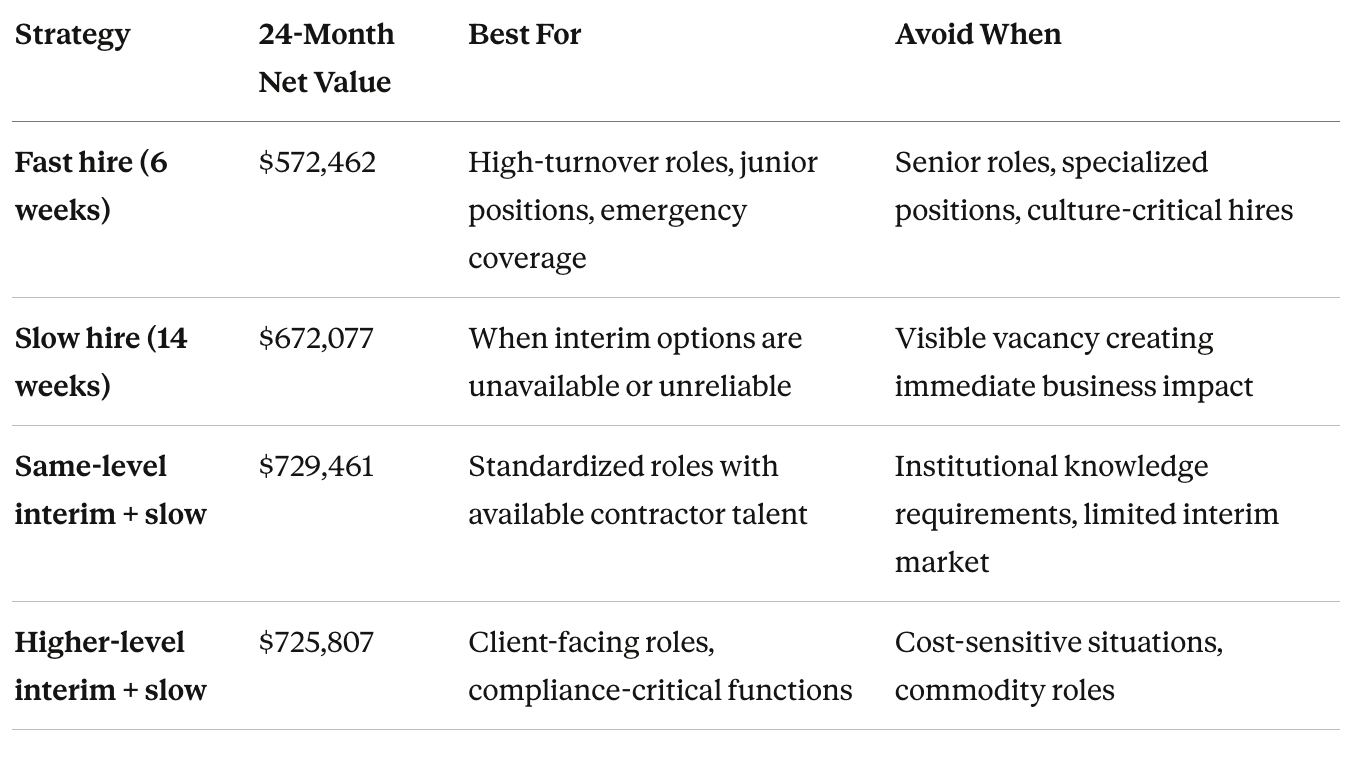
The optimal strategy isn't universal; it depends on role type, interim market availability, vacancy visibility, and organizational tolerance for short-term gaps.
When Speed Actually Wins
This is not an argument for always hiring slowly. Speed is economically optimal in specific circumstances:
High-Turnover Roles
High-turnover roles where tenure expectations are 12-18 months regardless of quality. If you're hiring retail associates or customer service representatives with 60% annual turnover, the value of finding 90th percentile candidates is minimal.
Hire fast, train adequately, and accept the churn. Interim coverage makes no sense here, the overhead exceeds the benefit.
Junior Positions
Junior positions with clear training paths and limited autonomy. An entry-level analyst's performance is largely determined by training quality and management, not innate talent differences.
The productivity spread between 60th and 85th percentile candidates is narrow enough that vacancy costs dominate. Again, interim strategies add complexity without proportional value.
Roles with Objective Performance Metrics
Roles with objective performance metrics where you can quickly identify and replace underperformers. If you can definitively measure output within 90 days and your termination process is efficient, the risk of mediocre hires decreases because you catch and correct quickly.
Emergency Coverage
True emergency coverage where immediate catastrophic costs exceed long-term quality costs. If a plant manager quits unexpectedly and the facility will literally shut down without coverage, hire someone adequate immediately, or deploy interim coverage for 2-4 weeks while you conduct an expedited but rigorous search for a permanent replacement.
The common thread: speed wins when quality differences are small, measurement is fast, and turnover is inevitable anyway.
When Quality Demands Patience (Or Interim Coverage)
Quality becomes economically essential, worth significant vacancy costs or interim expenses, in these scenarios:
Senior Leadership Roles
Senior leadership roles where a single hire influences dozens or hundreds of employees. A mediocre VP of Engineering doesn't just underperform personally; they make mediocre technical decisions that cascade through the organization for years. The productivity difference between 70th and 95th percentile leadership is not 25% - it's 200-300% when you account for organizational impacts.
For these roles, interim coverage from a fractional executive or experienced consultant typically delivers 70-80% productivity while you search for permanent excellence, a strategy that beats both fast-mediocre and vacancy by wide margins.
Specialized Technical Positions
Specialized technical positions where expertise is rare and mistakes are expensive. A mediocre security engineer creates vulnerabilities that might cost millions. A mediocre data scientist builds models that drive bad business decisions. The option value of waiting for genuine expertise far exceeds vacancy costs.
If interim contractors with relevant expertise exist (former CISOs doing fractional work, senior data scientists between roles), deploy them. If not, the vacant position still costs less than the wrong hire.
Culture-Defining Early Hires
Culture-defining early hires in high-growth companies. Your first ten employees set expectations for everyone who follows. Hire mediocre people early and they become the bar for "good enough," making it harder to attract excellent people later. Hire excellent people and they raise the bar, making your company more attractive to other excellent candidates.
Interim strategies work poorly here, culture is built by permanent employees, not contractors passing through.
Roles with Long Feedback Loops
Roles with long feedback loops where you won't discover mediocrity for 12+ months. Product managers, strategic planners, and business development leaders often work on initiatives that take years to show results. By the time you realize they're underperforming, you've lost 18 months and need to restart the search anyway.
For these positions, interim coverage from consultants or part-time executives can maintain momentum while you conduct a thorough search.
The common thread: quality wins when individual performance differences are large, impacts are multiplicative, and course correction is expensive or slow. In most of these scenarios, interim coverage from overqualified contractors offers the best economic outcome - if such contractors exist in your market.
The Real Trade-Off
The hiring speed versus quality decision isn't actually about patience versus urgency. It's about which uncertainty costs you more: the known cost of waiting, the unknown cost of choosing poorly, or the measurable cost of interim coverage while you find excellence.
Companies systematically underestimate the cost of choosing poorly because those costs arrive slowly, attributed to many causes, and often blamed on the employee rather than the hiring process that selected them. They systematically ignore interim strategies because the upfront cost is visible and immediate, even though the 24-month ROI typically beats both fast-mediocre and slow-vacancy approaches.
But the economics are clear. For professional roles with 2+ year tenure expectations, productivity spreads of 20%+ between quality tiers, and team collaboration requirements:
Interim coverage + patient search for excellence delivers 25-30% more value than fast hiring and 8-15% more value than slow hiring with vacancy.
Slow hiring with vacancy delivers 15-20% more value than fast hiring when interim options are unavailable or unreliable.
Fast hiring makes economic sense only when quality differences are minimal, turnover is inevitable, or emergencies demand immediate coverage.
The fastest hire isn't always the most expensive. But the fastest hire is almost never the most valuable. And the vacant position, while painful, often costs less than the wrong person in the seat.
Your recruiting metrics should reflect this reality. Time-to-fill matters, but time-to-productivity matters more. Cost-per-hire matters, but quality-of-hire matters more. Vacancy costs are real, but mediocrity costs are larger, and interim strategies can eliminate the false choice between the two.
The executives who understand this distinction build better teams, achieve higher productivity, and spend less on turnover and rehiring. The ones who don't hit their time-to-fill targets while wondering why their best employees keep leaving.
This article is part of The Hiring Economics Series, examining the economic frameworks and incentives that drive hiring decisions. Next in the series: "The Economics of Lowball Offers: Why Saving 10% Costs You 100%"